A Simple Way to Calculate the Financial Efficiency of Home Solar Power
Many folks message me saying formulas like IRR and NPV are a bit of a headache.
I totally agree. For households, I’m using a much simpler way of calculating things that’s still sufficient for making decisions.
The core idea comes down to just 2 numbers:
- The electricity bill you would have had to pay (if you didn’t have solar yet)
- The actual electricity bill you pay after installing the system
From there, you can immediately see whether you’re making a profit or not, and more importantly, you’ll know the actual unit price per kWh of electricity you’re paying.

1) The monthly calculation method I’m currently using
Step 1: Record the total kWh consumed in the month
Take the actual electricity usage in the month (from the utility app or the main meter).
Step 2: Calculate the “bill you would have had to pay”
Use that exact consumption level and apply the EVN tariff in effect at the time of calculation.
Step 3: Take the “actual bill paid”
This is the bill after your solar system has already offset your load.
Step 4: Calculate 3 key indicators
- Monthly savings = Bill you would have had to pay − Actual bill paid
- Pre-investment unit price of electricity = Bill you would have had to pay / Total kWh consumed
- Actual unit price of electricity after investment = Actual bill paid / Total kWh consumed
That’s it. No need for complex financial models and you can still clearly see the effectiveness.
2) My real-life example
From real operating data:
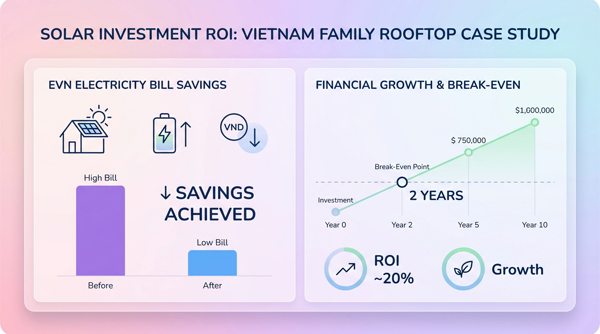
- The bill I would have had to pay (without solar): about 3.4 million VND/month
- The actual bill paid after optimal operation: about 1.55 million VND/month
=> Savings: about 1.85 million VND/month
If we convert to an average unit price of electricity at the same consumption level:
- Before investment: the unit price is clearly much higher
- After investment: the actual unit price drops sharply
This difference is what allows me to recoup my capital in about 24 months.
3) Why is there profit according to this simple calculation?
a) Investing early
Each month you delay is one month of lost electricity savings.
If you’re sure you’ll be using electricity long-term at your current home, then doing it early is usually better.
b) Matching your load
Solar power used on-site is the most valuable part.
The closer it matches your daytime load, the better the effectiveness.
c) Modest capacity is enough
I tend to go for just enough, not chasing an oversized system.
Start small to recoup capital quickly; once you have real operating data, then consider expanding.
4) Practical principles for choosing system capacity for households
- Prioritize offsetting important daytime loads first
- Don’t try to “cover 100% at all times” right from the beginning
- Choose a system that’s easy to operate and maintain
- Monitor for 2–3 months first, then decide whether to increase capacity
In short: start from small to medium, don’t oversize on day one.
5) Quick checklist before spending money
- Collect your last 12 months of electricity bills
- Determine your true daytime load
- Install a right-sized, load-matching system
- Track these 3 indicators every month:
- Bill you would have had to pay
- Actual bill paid
- Actual unit price of electricity after investment
Just by consistently following these 4 steps, you can manage financial effectiveness very well.
Conclusion
If you ask me in one short question: should you invest in solar power?
My stance is still very clear:
- You should invest early
- You should build a load-matching system
- You should start with a small, just-enough capacity
For households, there’s no need for overly complex calculations. Just track the “2 bills” correctly each month and you’ll know whether the system is helping you pay a cheaper electricity price or not.
If you need it, I’ll share a very compact tracking sheet (3 data columns) so you can check monthly effectiveness by yourself in 1 minute.