
Basics of Solar Power Systems and How to Choose Panels, Inverters, and Batteries
The electrical energy generated from solar panels is direct current (DC). To use it in a household, you need a device that converts the current and compensates the load. An inverter is an electronic device that converts direct current into alternating current, or vice versa, to suit electrical appliances. In this article I will only go into detail about the type of inverter used to convert electricity for home use.
Depending on the solar power system (grid-tied, off-grid, or hybrid), different types of inverters are used: On-Grid Inverter, Off-Grid Inverter, and Hybrid Inverter.
What is the difference between an On-Grid Inverter (load-following) and a Hybrid Inverter (with battery)?
A grid-tied solar system uses an On-Grid inverter to synchronize with the national grid, so it must have grid electricity available in order to operate. In addition, when there is a power outage, the system will automatically shut down to ensure the safety of grid maintenance/repair workers. Meanwhile, a grid-tied solar system with storage that uses a Hybrid Inverter will operate continuously: when grid power is available, the system works like a grid-tied system; when the power goes out, it operates like an off-grid system.
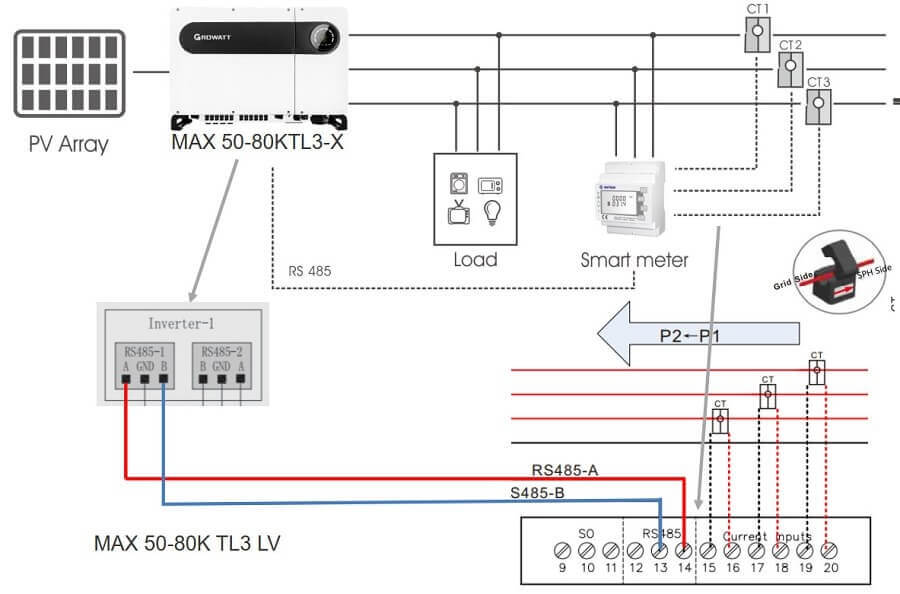
There is also another device in the system called a meter, which is responsible for distributing DC power to prevent electricity from the solar array from being fed back into the grid. At the time I’m writing this, EVN no longer bans feeding power back to the grid, but previously you were required to install this device, otherwise you would be fined.
I will also have a more detailed article on which type of inverter you should choose, or on popular inverter brands. Because depending on your needs you should invest differently, as the cost of an inverter that supports hybrid mode is much higher and its components are also more complex to repair.
Solar panels come in many sizes and power ratings – when should you choose which type?
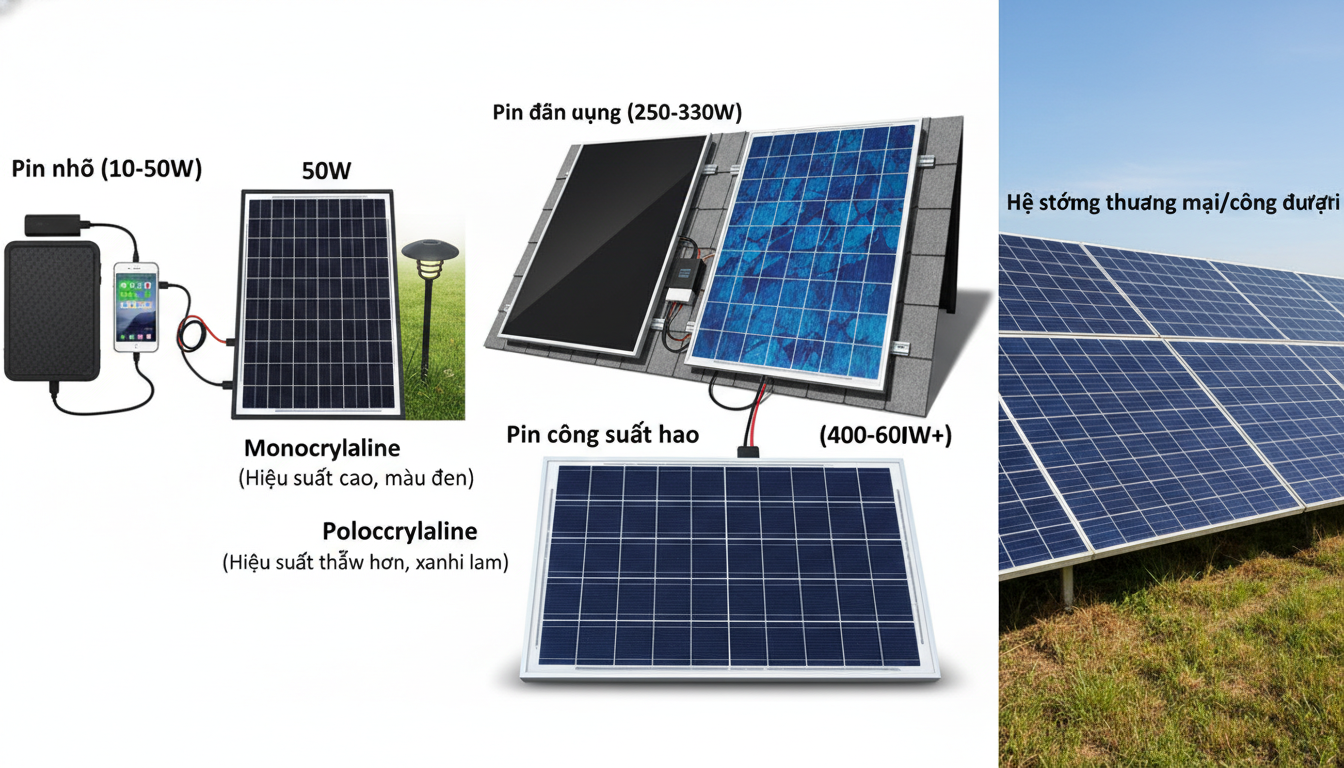
On the market there are many brands, sizes, and power ratings. The panel technologies also vary. In addition to the common sizes shown in the illustration, there are much smaller sizes; however, I don’t recommend buying types under 300W because of issues related to total system capacity.
For example, if you install ten 560W panels and on a bad day a hailstorm breaks one panel, your whole system will temporarily stop working. If at that point you remove the broken panel and re‑wire the string, the total capacity will drop a bit, but if you don’t understand and go buy a 450W panel to replace it, the whole system will then be limited to a maximum of 450W. That’s the simple way to understand it.
“There are many types of solar panels imported from China that are very cheap on the market, even though they are labeled Technology in Germany, in USA, in Japan… but most of them are assembled from discarded cells (rejected cells) that have a high rate of cracks and are non‑uniform when scanned with an EL machine. After being used for a period from one to several years, they easily suffer from voltage loss, and thus their lifespan decreases rapidly because the cracks inside expand under heat (since the cells in a solar panel are wired in series, one damaged cell means the whole panel is damaged).”
So it doesn’t mean the bigger the panel, the better. You should choose panels based on the actual available installation area and your potential for future expansion. With smaller panels, if one is damaged and needs replacement, the cost of replacing an entire panel is also lower.
Solar panels also come in many types with different technologies
| Type of solar panel | Advantages | Disadvantages |
|---|---|---|
| Mono (monocrystalline) | Highest efficiency. | High cost. |
| Poly (polycrystalline) | High efficiency. Reasonable price. | Lower performance/efficiency than Mono. |
| Thin-film | Lightweight. Flexible. | Lowest performance/efficiency. |
High‑end products currently, such as the LONGI brand that I’m using, are mono panels with a performance warranty of around 30 years. Almost all other brands are also using this technology; if you notice a panel that’s black with a glossy surface, that’s it. There are also many issues related to surface finishing, aluminum frame quality, heat dissipation, etc., that affect panel durability. The best approach is simply to pay attention to the seller’s warranty policy when choosing, instead of worrying too much about all the manufacturing technologies behind it.
Storage batteries come in many types and output voltages – which should you choose?
Storage batteries also come in many types. For me, daytime power consumption is what really matters; at night it’s cooler and I don’t use the air conditioner much, so investing in a storage battery system right now isn’t really necessary. Battery storage technology hasn’t yet matured enough to be commercially attractive at a reasonable cost. Currently, the best type is lithium; people no longer commonly use lead‑acid batteries for storage like in the past.
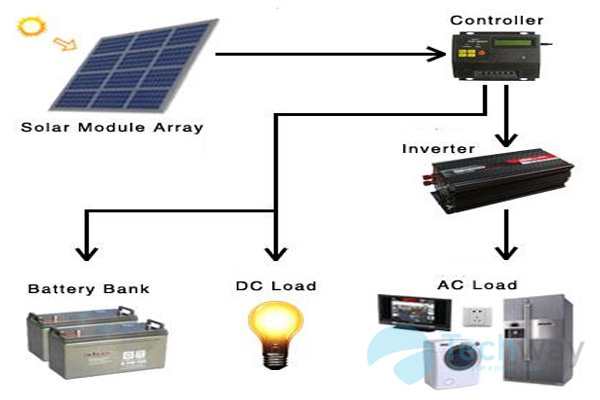
You can also start with a “grass” solar system to get familiar with things at a moderate investment cost, including panels. I haven’t tried this type myself because it feels a bit “unsafe” for my family’s usage needs.
Conclusion
The topic of solar energy requires quite a bit of knowledge because the market is highly fragmented, and prices are very diverse. From my experience, prices are now relatively stable; investing in a 5–6kWh system will cost around 35–40 million VND if you buy the components yourself and do the installation. It’s fairly easy to install as long as you know a bit about electricity and how to use a drill.
I hope this article provides enough basic information for everyone to start exploring this topic. If you have any questions, feel free to comment so we can discuss further.