When Do You Get a PIT Refund, and When Must You Pay More?
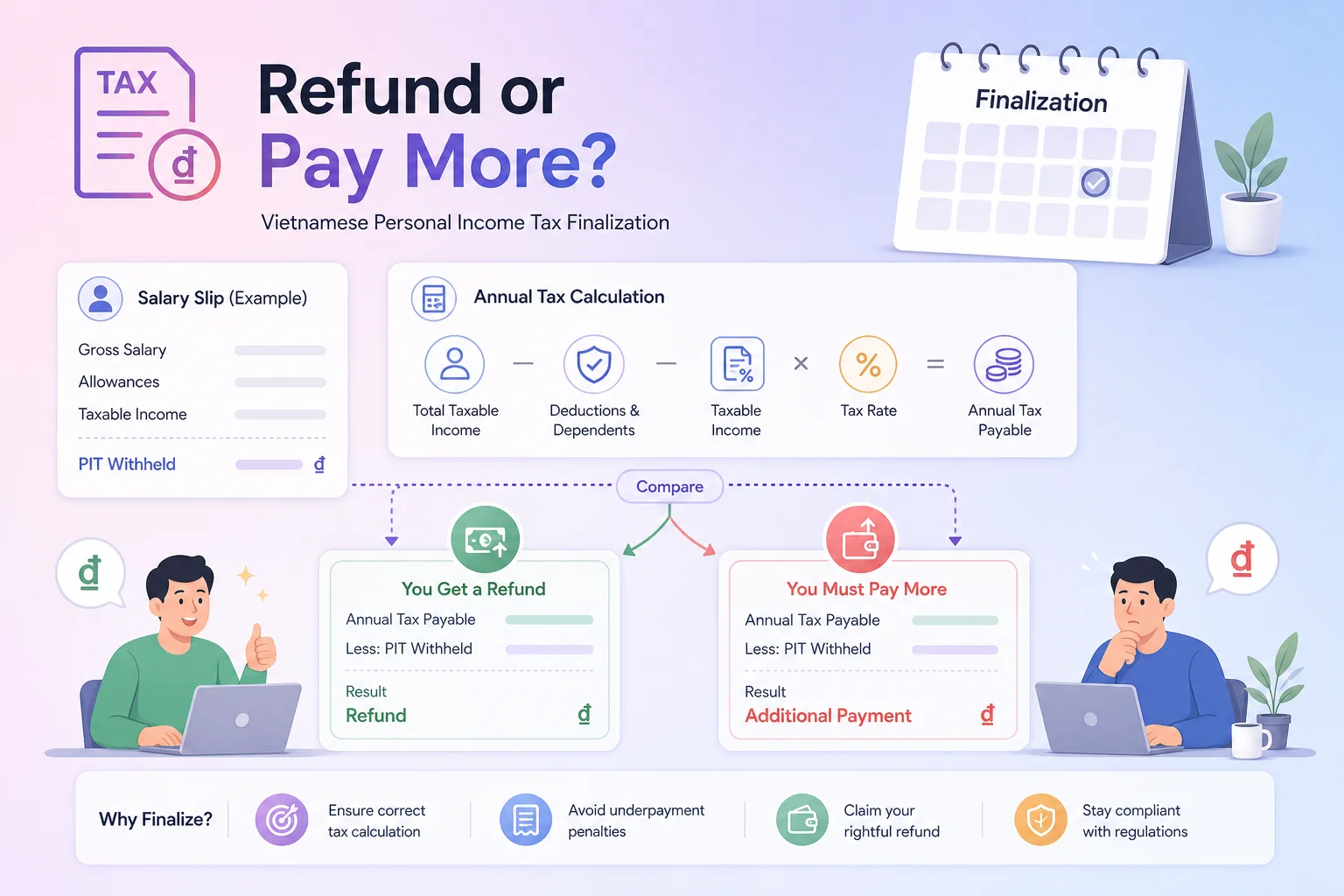
Annual PIT finalization is not always about paying more. It compares your full-year tax payable with tax already withheld or provisionally paid; overpaid tax can be refunded or offset, while underpaid tax must be paid additionally.
Every Vietnamese personal income tax finalization season brings up a practical question: will I get a refund, or will I have to pay more?
The short answer is that annual PIT finalization is a reconciliation step. The tax authority, or you when filing your own return, compares your total PIT payable for the whole year with the amount already withheld or provisionally paid during the year.
If withheld/paid > annual tax payable  -> you may get a refund or offset
If withheld/paid < annual tax payable  -> you must pay the difference
If the two are almost equal             -> little or nothing happens
This sounds simple, but real life gets messy when you change jobs, have multiple income sources, receive bonuses, get a raise mid-year, register dependents late, or have casual/freelance income withheld at 10%.
What Annual Finalization Actually Does
During the year, your employer usually withholds PIT each payroll cycle. If you freelance, receive casual income, or have other income sources, the payer may also withhold tax at source under the applicable rules.
But for a resident individual with salary or wage income, PIT is ultimately viewed on an annual basis. Monthly withholding is only an approximation. At finalization, the calculation brings together:
- Total taxable income for the year.
- Deductible items such as compulsory insurance, personal deduction, dependent deduction, and other eligible deductions.
- The progressive PIT schedule.
- Tax already withheld or provisionally paid during the year.
The difference decides the outcome.
Additional tax payable = annual tax payable - tax already withheld/paid
Refundable amount      = tax already withheld/paid - annual tax payable
If the first result is positive, you underpaid. If the second result is positive, you overpaid.
Why Do Some People Get a Refund?
A refund usually happens when more tax was withheld during the year than the final annual tax payable. Common cases include:
| Situation | Why overpayment can happen |
|---|---|
| Dependents were registered late | Payroll did not apply the full dependent deduction during the year; finalization recalculates it |
| You worked for less than 12 months | Some months had high withholding, but annual income after deductions may be lower than expected |
| Casual income was withheld at 10% | The payer withheld at a fixed rate, but your final taxable income after deductions may be lower |
| You resigned, changed jobs, or had months without income | Period-by-period withholding can be higher than the final full-year obligation |
| Payroll withheld conservatively | The company may have withheld more to avoid underpayment, leaving a surplus at year-end |
Example: you worked for six months and had PIT withheld in some high-income months. You then had six months with no income. When the year is finalized, personal and dependent deductions are considered under the annual rules, so your actual tax payable may be lower than the amount already withheld.
Another common case is casual income. Suppose you received freelance income and the payer withheld 10% before transfer. If your annual taxable income after deductions is not high, part of that 10% may be an overpayment that can be refunded or offset if you meet the conditions.
Why Do Some People Have to Pay More?
Additional payment happens when tax withheld during the year is lower than the final annual tax payable after all income is combined. Common cases include:
| Situation | Why underpayment can happen |
|---|---|
| You had multiple income sources at the same time | Each payer may withhold as if it were the only payer, but finalization combines the income |
| You received a raise mid-year | Annual income increases, especially if withholding was not adjusted enough |
| You received bonus, KPI pay, or a 13th-month salary | Taxable income increases at payment time and affects the annual total |
| Some outside income was not sufficiently withheld | Consulting, freelance, commission, or foreign-source income may need separate reporting |
| A dependent deduction was claimed incorrectly | Reversing the deduction increases taxable income |
The most confusing case is multiple income sources. If two companies paid you during the same year, or you had a full-time job plus consulting income, your year-end taxable income may be higher than each payer's separate withholding suggested.
Simple example:
Company A withholds based on income from A
Company B withholds based on income from B

At finalization:
Taxable income = income from A + income from B - eligible deductions
Because Vietnam uses a progressive tax schedule, combining the income can push part of it into a higher bracket. If the separate withholding was not enough for the combined annual income, you must pay the difference.
Does a Raise Always Mean You Must Pay More?
Not always.
A mid-year raise means your annual tax obligation may increase because your total annual income increases. But if payroll updates the calculation correctly and withholds enough each month, year-end finalization may not produce a large difference.
You are more likely to owe additional tax when:
- Payroll updates the raise late or calculates withholding incorrectly.
- A large bonus was paid but not fully withheld.
- You changed jobs and the new employer does not have complete income data from the previous employer.
- You have outside income that was not sufficiently withheld or provisionally paid.
Conversely, you can still get a refund despite a raise if the tax withheld during the year exceeds the final tax payable, or if dependent deductions reduce taxable income more than expected.
2026: Watch the Deduction and Tax Schedule Changes
From the 2026 tax year, according to information published by the Vietnamese Government portal based on the Tax Department's guidance, family circumstance deductions are adjusted as follows:
| Deduction | Amount from the 2026 tax year |
|---|---|
| Taxpayer's personal deduction | VND 15.5 million/month |
| Each dependent | VND 6.2 million/month |
The progressive PIT schedule has also been updated. The key concept is that a higher tax rate only applies to the portion of income that falls into that bracket, not to your entire income.
So if part of your taxable income falls into the 5% bracket and another part falls into the 10% bracket, the 5% part is still taxed at 5%. A raise does not make you "lose the whole raise"; your after-tax income still increases, although the incremental income may be taxed at a higher marginal rate.
5 Realistic Examples
1. One Employer, Stable Salary, Correct Payroll
This is the simplest case. Your employer has your salary, insurance, personal deduction, and dependent information. If monthly withholding was correct, year-end finalization usually has little difference.
You may be able to authorize the employer to finalize on your behalf if you meet the conditions for that tax year. Otherwise, you file your own return.
2. You Had a Child but Registered the Dependent Late
During the year, payroll may not have applied the dependent deduction, so more tax was withheld each month. At finalization, if the dependent record is valid and applies to the relevant period, taxable income decreases.
Common result: you may receive a refund or reduce the amount payable.
3. You Changed Jobs During the Year
You worked at Company A for a few months, then moved to Company B. Company B usually only has income data from B unless the required documents and conditions are available.
If total annual income after combining A + B is higher than the amount each company withheld separately, you may have to pay more. But if there was a gap between jobs or the previous employer withheld conservatively, you may still get a refund.
4. You Had a Full-Time Job and Freelance Income
Salary is your main income source, while freelance income may be withheld at 10% when paid. At year-end, look at the whole picture:
Total income = salary + freelance income
Tax paid     = employer withholding + freelance withholding/provisional payments
If the 10% freelance withholding is higher than the final obligation after deductions, you may get a refund for the surplus. If total income is high and the withholding was not enough, you must pay more.
5. You Received a Raise and a Year-End Bonus
You got a raise in September and a bonus in December. Annual income rises sharply near year-end. If the employer withholds correctly at payment time, finalization may only create a small adjustment.
But if withholding was too low, or if you also had other income sources, the bonus and raise may push more income into higher tax brackets, resulting in additional tax payable.
When Do You Need to File Yourself?
Not everyone can authorize their employer to finalize PIT on their behalf. If you had multiple income sources, changed employers, had casual income that needs separate handling, or want to claim a refund, check the conditions for the relevant tax year carefully.
Guidance from tax-related sources indicates that individuals with income from two or more payers often need to self-finalize in many situations, especially when they do not meet the conditions to authorize one income-paying organization. The important point is: do not assume "my employer withheld tax, so I am done." Employer withholding is only part of the picture.
Should You Claim a Refund?
If the surplus is small, some people choose to offset it against a later period instead of requesting a cash refund. If the amount is meaningful, you should consider filing for a refund or using electronic channels such as eTax/eTax Mobile if your case is supported.
The tax authority has been rolling out electronic/automated PIT refund support for some situations. Still, keep the documents:
- PIT withholding certificates.
- Labor contracts, resignation decisions, salary increase decisions.
- Payslips or annual income summaries.
- Dependent registration information.
- Documents for casual/freelance income, if any.
Quick Checklist Before Finalization Season
Before submitting your PIT finalization, ask yourself:
- Did I work for more than one company this year?
- Did I have unpaid leave, months without salary, or a job gap?
- Did I receive freelance, consulting, commission, or collaborator income?
- Did I receive bonus, 13th-month salary, KPI pay, stock-related compensation, or a one-off payment?
- Are my dependents registered correctly and for the right period?
- Do I have withholding certificates from the previous employer or outside payers?
- Does the tax already recorded on eTax match the documents I kept?
If many answers are "yes", do not rely only on one year-end payslip. Collect the full-year data and reconcile it.
Bottom Line
Whether you get a refund or pay more does not depend on the vague feeling that your salary is high or low. It depends on a specific comparison:
Annual tax payable
versus
Tax already withheld or provisionally paid during the year
You are more likely to get a refund when tax was withheld above your final obligation, especially if you have dependent deductions, worked less than a full year, had casual income withheld at 10%, or changed jobs with a gap.
You are more likely to pay more when you had multiple income sources, received a raise or bonus that increased annual income, or had income that was not sufficiently withheld.
Once you understand this logic, tax finalization becomes less intimidating. Keep your documents, check the data on the tax system, and remember that annual finalization is a year-end reconciliation, not an automatic penalty.
Sources
- Vietnam Government News - eTax Mobile supports personal income tax refunds
- Vietnam Government portal - deadline for 2024 PIT finalization
- Vietnam Government portal - family circumstance deductions for PIT
- Vietnam Government portal - progressive PIT schedule
- Vietnam Government portal - place of PIT finalization for people with multiple income sources
- Thu Vien Phap Luat - how individuals with income from two or more places finalize PIT