What Solar Panel Wattage Should You Buy?
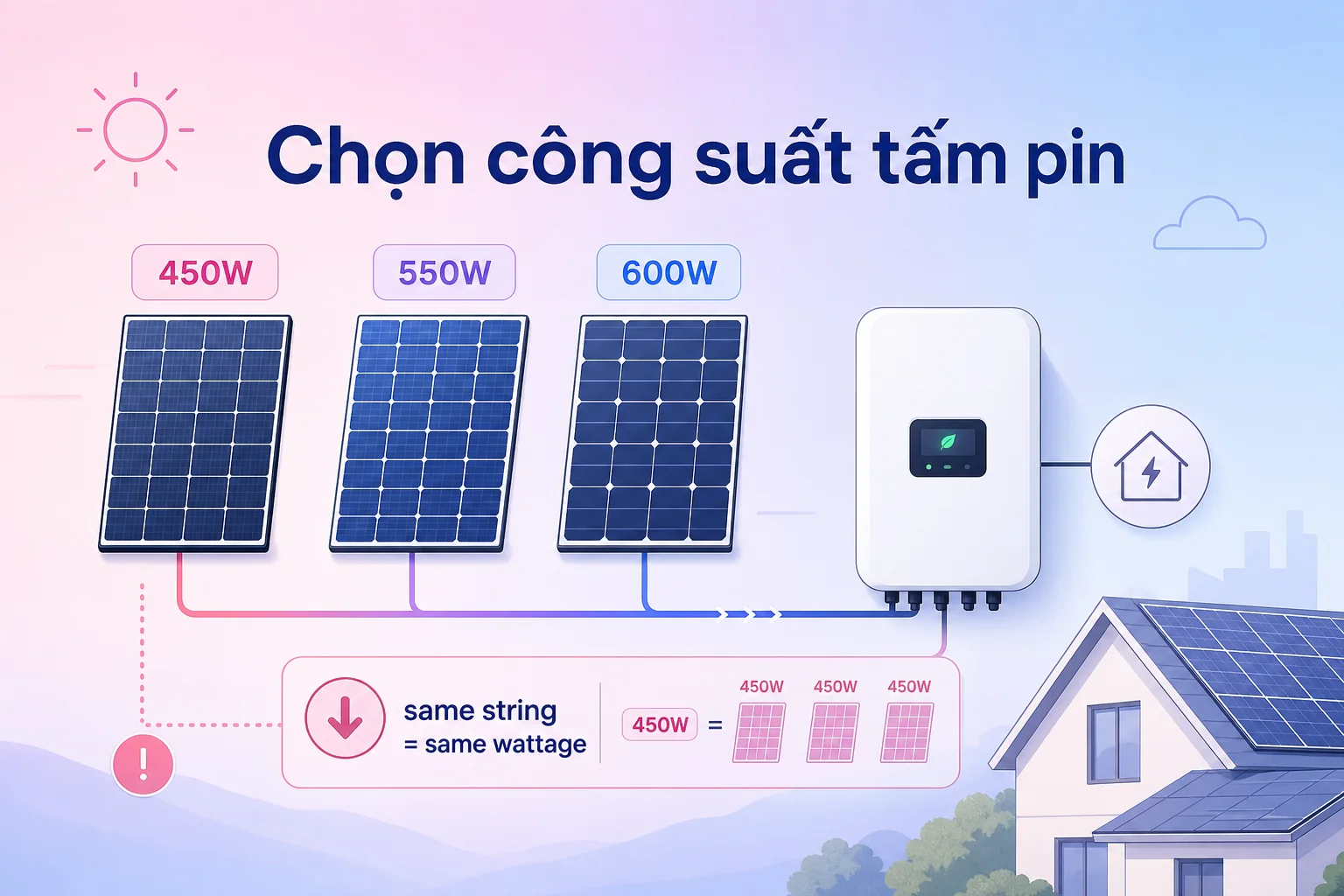
Should you buy 450W, 550W, or 600W solar panels? For a home solar system, do not choose by panel wattage alone. Use the same model and wattage within each string, and check the inverter, roof layout, and price per Wp.
If you are new to rooftop solar, the market can feel confusing very quickly. You will see 400W, 450W, 500W, 550W, 600W, and even commercial modules around 650W-700W. At first glance, the highest wattage panel looks like the best choice, but a good solar system is not selected by the number printed on one panel alone.
For a typical home solar system, my short answer is:
If you are installing a new system from scratch, choose a popular solar panel model that is easy to buy again later, and keep the same wattage across the whole string or array section. Right now, 500W-550W panels are often the most balanced option. If your roof is small, has a complicated layout, or needs smaller panels to fit around obstacles, 430W-450W panels can still be the better choice. Do not force 600W-700W panels into a home system just because the wattage number is larger.
The most important rule is simple: do not randomly mix panels with different wattages in the same string.
Why you should not mix 450W, 550W, and 600W panels in the same string
Solar panels are usually not connected one by one directly to the inverter. Several panels are wired together into a string. In a series string, the current through each panel has to move together. If one panel is weaker, has a lower operating current, has different electrical characteristics, is shaded, or has degraded more than the others, the whole string can be pulled down by that weaker panel.
A simple way to remember it:
A solar string only performs well when the panels in that string move at the same pace. One lower-performing panel can drag the whole string closer to its level.
For example, imagine one string with 10 panels:
- 9 panels rated at 550W
- 1 panel rated at 450W
Many people would calculate the total as 9 x 550 + 450 = 5,400W. In real operation, the 450W panel may limit the current of the entire string. The loss is not always just the missing 100W from that one panel. It can make the whole string run below the design point.
The exact output depends on Vmp, Imp, the IV curve, the inverter MPPT, sunlight, temperature, and shading. But the buying rule is clear: panels in the same string should ideally use the same model, same wattage, and same production generation.
PV Education describes mismatch loss as loss caused by cells or modules having different characteristics or operating conditions. In some cases, the output of the module or array section can be determined by the lower-output part.
So what wattage should you choose?
Instead of asking "which panel has the most watts?", ask these questions in order:
- How many identical panels can my roof actually fit?
- What voltage and current range does my inverter MPPT support?
- How many panels will each string have?
- What is the final price per Wp for each option?
- If I need a replacement later, can I still buy the same model and wattage?
Once you answer these questions, the right choice becomes much clearer.
430W-450W panels: flexible for small or complicated roofs
This group is still very practical for townhouses, small roofs, and roofs with many obstacles. Smaller panels are usually easier to rotate, place around water tanks, rooftop rooms, technical gaps, AC outdoor units, and vents.
Choose this group if:
- Your roof is not large or has an awkward shape.
- You need to split the array into several smaller roof sections.
- The price per Wp is meaningfully better than larger panels.
- Your installer is familiar with this size and has enough identical panels in stock.
The tradeoff is that you need more panels for the same system size, which can mean more mounting points, more wiring, and more installation work.
500W-550W panels: the balanced choice for many home systems
In the current market, this is the group I would prioritize for a new home system when the roof has enough usable space. These panels give you more wattage per module than 450W panels while still being less awkward than many 600W-700W modules designed mainly for larger projects.
Choose this group if:
- Your roof is wide enough for a clean panel layout.
- You want fewer panels and fewer connection points.
- Your inverter MPPT is compatible with the planned number of panels per string.
- You can buy one synchronized batch of the same model and wattage.
For example, a 5.5kWp system can use 10 panels rated at 550W. With 450W panels, you would need around 12-13 panels to reach a similar system size. If the roof layout is clean, 550W panels can make the system simpler.
600W and above: not always better for a home roof
Very high wattage panels often reach that number partly because they are physically larger, not only because they are more efficient. EnergySage also notes that higher wattage does not automatically mean a panel is more efficient; output depends on both panel size and efficiency.
Be careful with 600W+ panels if:
- Your roof is small or has many dead zones.
- The panel is difficult to bring onto the roof or position safely.
- Your inverter has MPPT current limits that do not fit high-current panels.
- You can only buy a few panels and are not sure you can get the same model later.
Panels around 600W-700W make more sense for factories, large roofs, fewer obstacles, experienced installers, and a string design that is calculated correctly from the beginning.
Do not only look at watts. Look at Wp per roof area
Two panels with the same wattage are not always the same. A high-efficiency 450W panel can be smaller than a lower-efficiency 450W panel. A 600W panel may sound strong, but if it is much larger, its power density on your roof may not be better.
Compare these specs:
- Rated power: for example 450W, 550W, or 600W.
- Panel dimensions: to check whether it fits the roof.
- Module efficiency: especially important if roof space is limited.
- Vmp/Imp: operating voltage and current for string design.
- Voc/Isc: open-circuit voltage and short-circuit current for inverter safety limits.
- Product warranty and power degradation warranty.
- Future availability for replacement panels.
If the roof is large, you do not always need the highest efficiency panel. If the roof is small, efficiency and W/m2 matter more.
A quick selection formula
Use this process when talking to a supplier:
- Decide the system size you want, such as 5kWp, 8kWp, or 10kWp.
- Choose a common panel wattage that the supplier has enough stock for, such as 550W.
- Calculate the number of panels:
system size / panel wattage. - Check whether the roof can fit that exact number of panels.
- Check whether the inverter can handle the planned string size using Vmp, Voc, Imp, and Isc.
- Finalize one model and one wattage for each string.
Examples:
- Around 5.5kWp: 10 panels rated at 550W.
- Around 6kWp: 11 panels rated at 550W, or 13 panels rated at 450W.
- Around 10kWp: 18 panels rated at 550W, or 22 panels rated at 450W.
These are only examples. For a real installation, the inverter, roof, sun direction, voltage limits, and current limits still need to be calculated properly.
What if you already have an older system and want to expand it?
This is where people often make the wrong purchase. You may have installed 450W panels a few years ago, then later find that the market has moved to 550W or 600W panels. If you simply add the new panels into the old string, you may create mismatch losses.
Better options:
- If you can still buy the same old model and wattage, buy that exact type.
- If not, put the new panels on a separate MPPT input if the inverter has one available.
- If the inverter has no free MPPT input, consider a secondary inverter, microinverter, or optimizer.
- Do not wire new panels with different wattage into the old string just because they are all "solar panels".
If you already know you may expand later, pick a common model from the beginning, choose a brand likely to stay available, or leave room for a separate MPPT path for the future expansion.
Final recommendation
If I had to summarize the practical buying decision:
New home system with enough roof space: choose 500W-550W panels, same model and wattage for each string. This is a good balance between panel count, availability, installation work, and performance.
Small roof or difficult layout: choose 430W-450W panels, or compact high-efficiency panels. Do not force oversized panels onto a roof where they cannot be arranged cleanly.
Factory roof or large open roof: 600W+ panels can make sense, but only after checking MPPT current, panel dimensions, weight, and installation method.
Older system expansion: prioritize the exact old panel model. If that is not available, separate the new panels into a different string or MPPT path instead of mixing them.
Checklist before placing the order
Before paying the supplier, ask these 7 questions:
- Are all panels in the same string the same model and wattage?
- How many strings will each inverter MPPT handle?
- How many panels are in each string?
- Will Voc in cold weather stay within the inverter limit?
- Will Isc/Imp stay within the inverter MPPT current limit?
- If one panel fails later, can I still buy the same model and wattage?
- What is the final price per Wp, including mounting frame, wiring, surge protection, and installation?
Answer these clearly and you will avoid most mistakes caused by choosing panels based only on a big 600W number.
Related reading
If you are also calculating the financial return and smart-home side of solar, these Geek Playground articles are useful:
- 2-year payback for rooftop solar: real-world investment experience to optimize EVN electricity bills
- List and Popularity Levels of Solar Panel Manufacturers
- Solar energy flow card for Home Assistant
- Connecting JK BMS with HASS and advanced automation scenarios