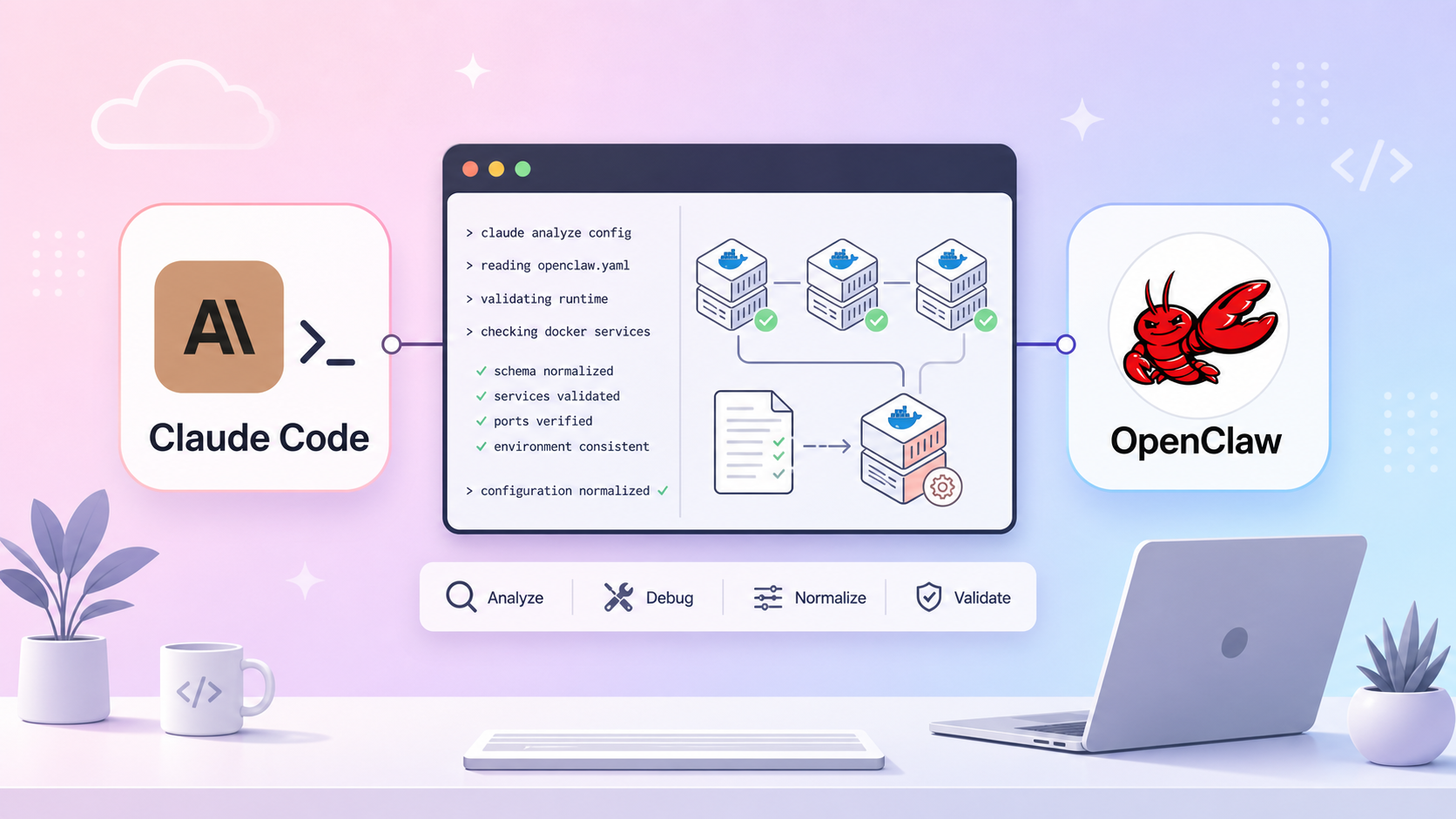
Fixing OpenClaw Configuration: Beyond the Built-in Doctor Tool
If you are using OpenClaw and encounter a situation where running openclaw doctor --fix multiple times or copying configurations from elsewhere still ultimately fails — the issue is likely beyond the capabilities of the built-in diagnostic tool.
The Problem: openclaw doctor --fix isn't always enough
OpenClaw has a built-in openclaw doctor --fix command to self-diagnose and fix configuration errors. This is a quick and convenient solution, but it has limitations:
- Only fixes known errors. The doctor tool operates on pattern matching — if your error falls outside its predefined list of rules, it will ignore it or apply an incorrect fix.
- Lacks understanding of your specific context. Whether a config key's value is valid or not depends on the provider you use, the model you choose, and your Docker setup — the doctor doesn't see this whole picture.
- Can over-correct or under-correct. I've encountered cases where the doctor resets the config to defaults, overwriting perfectly fine running parts — resulting in the service failing even worse than before.
The Solution: open Claude Code in the OpenClaw directory
Instead of relying on automated tools, use Claude Code — open it right in the directory containing the OpenClaw configuration.
cd ~/openclaw   # or your OpenClaw installation directory
claude
When Claude Code starts here, it has direct read access to all files in the directory: openclaw.json, docker-compose.yml, runtime logs, AGENTS.md, .env — all the necessary context to accurately understand the current state of the system.
This is the core difference: Claude Code reads actual files on your machine and understands the specific context — something openclaw doctor --fix cannot do.
7-Step Configuration Standardization Process
Step 1: Read logs and config — without making any changes yet
The first step is to collect data. Ask Claude Code:
"Read all configuration files and OpenClaw startup logs in the current directory. Group recurring errors, identify the root cause of failures, and propose an inspection order from highest to lowest probability."
Claude Code will use Read, Grep, Glob to scan real files, not guess from the prompt.
Step 2: Cross-reference with official documentation
After establishing an error hypothesis, ask Claude Code to cross-check it against the docs of the version you are running:
"Cross-reference the current configuration with the official guide for the specific version in use. Point out discrepancies and the impact level of each point."
Goal:
- Detect incorrectly named config keys (changed across versions).
- Detect fields that are syntactically valid but semantically incorrect at runtime.
- Detect redundant configs causing conflicts.
Step 3: Minimal changes
Golden rule: every change must be justified by the logs; do not fix what is already working fine.
"Only apply minimal changes to restore stable startup capabilities. For each change, clearly state: what was changed, why it was changed, and the risk of not changing it."
Claude Code will use Edit to directly modify the config file — you see the exact line-by-line diff before approving.
Step 4: Configure a fallback model
Once the service is stable, add a fallback model to prevent bottlenecks when the primary model fails:
- Primary model + at least 1 backup model.
- Clear fallback priority order.
- Fallback conditions: timeout, quota exceeded, provider error.
- Test call each model after configuration.
Step 5: Standardize AGENTS.md
Many failure cases are not related to Docker but stem from overly vague agent role descriptions. Ask Claude Code to review and standardize:
- Main agent acts as an orchestrator, always on standby to receive user requests.
- Long/slow tasks are offloaded to sub-agents.
- Sub-agents report checkpoints at each milestone.
- Main agent synthesizes results and responds consistently.
Step 6: Verify after fixing
Mandatory checklist after each fix cycle:
- [ ] Service starts up stably after a restart.
- [ ] No more recurring startup errors in the new logs.
- [ ] Primary model is callable.
- [ ] Fallback model is callable.
- [ ] Main agent → sub-agent flow runs according to their proper roles.
If it fails, return to step 1 and read the new logs — no emotional rollbacks.
Step 7: Repeat if necessary
This process is a controlled loop: read logs → cross-reference → minimal changes → verify. Each cycle is based on new data, no guesswork.
Comprehensive Prompt — copy and use immediately
Open Claude Code in the OpenClaw directory, paste the following prompt:
"Objective: Standardize OpenClaw configuration for a stable startup.
Please follow this order:
1) Read all logs and configs in the current directory, determine the root cause.
2) Cross-reference with the official documentation for the correct version.
3) Propose minimal changes to restore startup.
4) Apply fixes, explain each change.
5) Set up a fallback model (primary + backup).
6) Standardize AGENTS.md so the main agent orchestrates its role correctly.
7) Run the verification checklist and report the results for each item."
Conclusion
When openclaw doctor --fix can no longer help, don't run it yet again. Open Claude Code right in the OpenClaw directory — to let a tool with permissions read real files, see real logs, and accurately fix every config line.
The core process is just that: read logs → cross-reference → minimal changes → verify. It is simple but far more effective than describing errors via chat and hoping the agent understands on its own.